Showing posts with label Toddler 24 to 36 months old: Cognitive. Show all posts

Monday, May 18, 2015

Games for Children Between the Ages of 1 - 4

السلام عليكم ورحمة الله وبركاته

Alhamdulillaah, there are many beautiful, well-made toys for young children. These toys have the potential to keep children engaged for substantial amounts of time and they provide crucial learning that aides in development. Today, in'shaa allaah, some will be presented here, and later, craft ideas and activities that cost little or no money will be posted, that children will enjoy in'shaa allaah.  

The first toy is a Junior Ramp:


Children between the ages of 1 1/2 - 3 years old may enjoy sending the different colour cars down the ramp numerous time while they engage in imaginary play. 

The second and third toys, a Wooden Triangle Stacker and a Wooden Square Stacker give children between the ages of 1 1/2  - 3 years old the ability to practice developing their hand-eye coordination. 


The next toy is Small Wooden Stacking & Nesting Bowls, Natural

Young children will spend time learning about size and sequencing and they will also work on fine motor skill development. 

The last toy is a Little Lock Box:
This wooden box has compartments where children can hide objects and toys, it provides pincer-grip practice, and it helps children practice their coordination and manual dexterity skills. Plus, it is very attractive!

Toys such as those presented in this post teach children essential fine motor, hand-eye coordination and manual dexterity skills, and they also have the potential to provide children will quality play that lasts for a sustained period of time. 

Check back soon for crafts and activity ideas that cost little or no money and use materials that are commonly found around the house.
  

Sunday, August 11, 2013

Ages & Stages: What Can Most Children Do - 2 Year olds

السلام عليكم ورحمة الله وبركاته

Back-to-school is around the corner insha'Allaah. Let's get started by reviewing developmental information for 2 to 5 year olds insha'Allaah. Familiarizing ourselves with this information will aide us greatly when we begin planning our curriculum.


Two-year-olds like to be independent! Favorite words are "Mine" and "No" and "I do it!" Emotions take on a roller coaster-like quality as 2-year-olds can go from excitement to anger to laughter within a few moments. A great deal of time is spent exploring, pushing, pulling, filling, dumping, and touching.

Two-year-olds are surer of themselves and of what they can do as they grow. Their bodies stretch out, and most will lose the potbellied look during this third year of life. Their appetites lessen, and they may be particular about food. They are still growing fairly rapidly.

Toddlers are very attached to their caregivers. You may find them trying out new ideas and exploring their surroundings, but still staying close to you as they need a base of support and trust. Two-year-olds are usually interested in other children. However, social interest and physical abilities sometimes collide as a hug becomes a tackle and a gentle pat becomes a whack. You will need to teach children how to express affection appropriately.


SOCIAL AND EMOTIONAL DEVELOPMENT
  • plays alongside others more than with them
  • acts shy around strangers
  • likes to imitate parents
  • easily frustrated
  • affectionate - hugs and kisses
  • insists on trying to do several tasks without help
  • enjoys simple make-believe like talking on phone, putting on hat
  • very possessive - offers toys to other children but then wants them back
  • needs considerable time to change activities
  • capable of frequent tantrums, which are often a result of his inability to express himself even though he has ideas
  • can show aggressive behavior and the intent to hurt others
  • can be extremely demanding and persistent
  • destructive to objects around him when frustrated and angry
  • possessive about caregiver's attention; shows feelings of jealousy
  • has fears and nightmares
  • has sense of humor; capable of laughter
  • shows interest in dressing, brushing hair and teeth
  • cannot sit still or play with a toy for more than a few minutes
PHYSICAL DEVELOPMENT
  • weight: 22-38 pounds
  • height: 32-40 inches
  • has almost a full set of teeth
  • walks up and down stairs by holding onto railing
  • feeds self with spoon
  • experiments by touching, smelling, and tasting
  • likes to push, pull, fill, and dump
  • can turn pages of a book
  • stacks 4-6 objects
  • scribbles vigorously with crayons or markers
  • many children (but not all) will learn to use toilet
  • walks without help
  • walks backwards
  • tosses or rolls a large ball
  • stoops or squats
  • opens cabinets, drawers
  • can bend over to pick up toy without falling
INTELLECTUAL DEVELOPMENT
  • enjoys simple stories
  • uses 2-3 word sentences
  • says names of toys
  • hums
  • enjoys looking at books
  • points to eyes, ears, or nose when asked
  • repeats words
  • interested in learning how to use common items
 
 
Suggestions for Caregivers:

Baby-proof your house again. Two-year-olds are taller and more skillful at opening doors and getting into mischief.
  • Read aloud to children every day. Encourage toddlers to look at books with large pictures and sturdy pages. Simple story lines are best.
  • Try to expand a 2-year-old's knowledge of words and sentence structure. Let her hear the correct word order, but don't demand that she imitate you. For example, if she says "more juice," say "Anna wants more orange juice."
  • Encourage them to identify noises like vacuum, tap water, thunder, airplane, and car.
  • Let toddlers help you with simple chores such as picking up toys or putting clothes in the laundry basket. Encourage them to name things that you are using.
  • Add new information to what a child is saying. "Yes that's a blanket, a soft, warm blanket."
  • Give toddlers clear and simple choices. "Do you want to drink milk or juice? Do you want to wear green or blue socks?"
  • Know how to handle a temper tantrum:
    1. don't yell or hit the child,
    2. remain calm,
    3. talk in soothing tone,
    4. put your hand gently on child's arm if possible.
  • Provide newspaper, flattened grocery sacks, and computer scraps for drawing and painting. Color books, workbooks, and ditto sheets are not recommended.
  • Avoid making models of clay or drawing pictures for children to copy. They learn more by working out their own ideas, and adult-induced items can actually hinder learning.
  • Do not expect toddlers to share or take turns. Right now they are focused on learning how to physically handle themselves and on learning to talk. Learning to share will come later.
  • Provide spaces where toddlers can spend time alone. An old cardboard box or a blanket over a card table works great.
  • Avoid pressuring children to be right or left handed. A few 2-year- olds will begin to show preference for one hand, but many children will continue to use both hands for a few years (AMCIB note: the exception here is eating and using the bathroom - follow the Islaamic guidelines for use of right and left hand).
  • Provide safe outlets for physical activity and space exploration like small steps, boxes, barrels, tires, pulling and pushing toys, ride-on and ride-in toys.
  • Provide opportunities for learning about cause and effect by giving toddlers many opportunities to fill, dump, collect, gather, give, hide, and seek.
  • Play "parade" or "follow the leader."
  • Encourage verbal skills by giving simple directions like "Close the door, please" or "Would you pick up the doll?"
  • Encourage a toddler's love for imitation by teaching fingerplays. Play "you are a mirror." Stand or sit facing the children and have them copy everything you do. Reverse roles and let the child lead while you mirror the actions.
  • Encourage sand, mud, and clay play. Toddlers enjoy messy play and learn a great deal from mixing, sifting, pouring, stirring, and shaping.
Reprinted with permission from National Network for Child Care -NNCC. Oesterreich, L. (1995). Ages & stages - two-year-olds. In L. Oesterreich, B. Holt, & S. Karas, Iowa family child care handbook [Pm 1541] (pp. 199-201). Ames, IA: Iowa State University Extension.

Friday, May 18, 2012

Toddler Butterfly Crafts, Activities and Books

السلام عليكم ورحمة الله وبركاته

These are a few books and activities that can be used when teaching about butterflies to toddlers and preschoolers insha'Allaah.

For storytime, you may wish to read aloud Ana alfaraashah and for reference you may find the book Ten Little Caterpillars helpful or it can be part of your selection of books for a unit on butterflies insha'Allaah.


The book Ana alfaraasha, like all of the books in this really wonderful series, has a bookmark inside of the book attached with a piece of ribbon. Each book mark is the animal featured in the story. Infants may also enjoy these beautiful board books as well. When using this book for toddlers, they can make butterfly book marks after hearing the story read aloud:


For the book Ten Little Caterpillars, there are many crafts and activities that can be done using this book as well.

The story of Ten Little Caterpillars ends with one of the caterpillars turning into a butterfly. For this part of the story, you can make flannel/felt pieces for your read aloud and invite children to come up and help tell the story with the pieces as you read:


The felt pieces show the apple tree branch that the caterpillar attached itself to, the chrysalis of that butterfly and the chrysalis of the Monarch butterfly, and the Tiger Swallowtail Butterfly that the caterpillar turned into. Not pictured: the little caterpillar that climbed the tree branch.

If you're wondering why there are two chrysalises pictured, it is because if you've talk a bit about how a caterpillar changes into a butterfly by the Permission of Allaah and you use the last three pages in the back of Ten Little Caterpillars as a teaching tool, later children can see if they remember which chrysalis belongs to the Tiger Swallowtail Butterfly at the end of the story.

The last three pages of the Ten Little Caterpillars show different caterpillars and the type of butterfly or moth they change into. The pages also briefly mention what type of food each caterpillar eats. Using those pages, you can make caterpillar cards and butterfly cards for some (or each) of the caterpillars and butterflies in the story. Below are the caterpillar and butterfly cards for four of the butterflies in the story.

In your literacy centre or after you have read the story with your little one you can lay the cards out and invite the child to match the caterpillar to the correct butterfly. For this age group, have the book ready to be used for help insha'Allaah.


Children can also do many other crafts involving butterflies, and they can learn the basic parts of the butterfly and label them on a worksheet. The picture of the butterfly can be found here insha'Allaah (in the section labeled Art, scroll down; it is the seventh (7th) file for download).


If you use this in your Kindergarten unit on Butterflies, you can also introduce symmetry. You can find worksheets here and here.

Enjoy insha'Allaah!

Sunday, February 26, 2012

Game ideas for 2 and 3 year olds

السلام عليكم ورحمة الله وبركاته

These game ideas can be used when teaching concept development, pre-reading skills and other cognitive skills to 2/3 year old children. They can be used in the classroom as well as the homeschooling environment. 


Shadow Matching

This shadow matching game is a little more advanced than those commonly found on the Internet. The pictures in this game have a bit more dimension and are somewhat more complex in shape. When children have used and mastered the shadow matching game in this post, you may find that this game is a great next step. This game is not free and can be purchased and downloaded from this site insha'Allaah. There are 15 photographic images of objects and 15 silhouettes of the objects in the file.


Beginning Sounds game

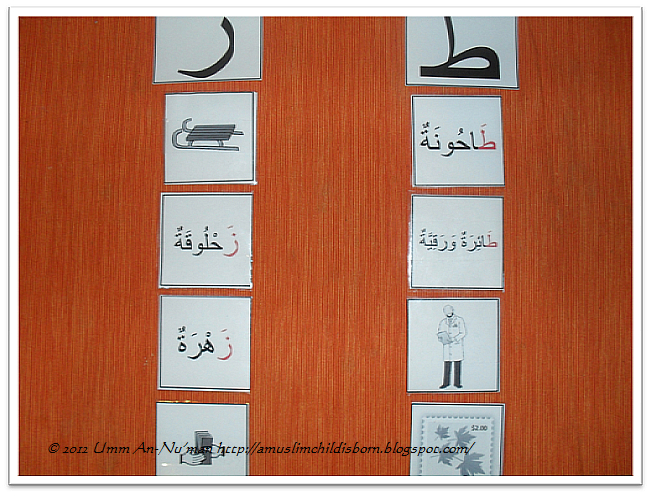
This game idea is helpful when studying the letters and the sounds they make. It is also helpful when children begin identifying the beginning sounds they hear in words. The game also helps build students' vocabulary. The teacher/teacher-parent can introduce new and more complex words to children as the children study the alphabet. The teacher/teacher-parent sits with the child and tells him/her what the object is on each card (if the child needs this support) and the child, listening for the beginning sound in the word, places the card under the letter that represents the beginning sound he/she hears. The child is listening for the beginning sound in each word but in the process he/she will also acquire new words and expand his/her vocabulary insha'Allaah. You may wish to start with 1 or 2 letters (with object/word cards for each letter) only when playing this game and as students gain skill and confidence you can use 3-4 letters (and object/word cards). If laminated, this game can be used in your classroom each year and will, insha'Allaah, withstand student handling. 
 
Children self-correct with ease in this game which makes it ideal for learning centres. To confirm if they have placed the cards in the correct row, children simply turn the cards over one at a time and check to make sure the first letter - highlighted in red - is the same letter on the letter card at the top of the mat. Children do not need to know how to read to play this game.


Control of Error

The next game helps children work on concept development. 

What Goes Together Game

Children are presented cards and must decide which cards go together. This association is based on how we use objects and/or how objects are complimentary. The teacher/teacher-parent prepares cards that show objects that he/she is confident his/her students are familiar with and know the usage of (i.e. the object).  

One way this game can be used is: the teacher presents the lesson and may begin with four cards (i.e. two pairs of objects). For example, the teacher may present a card with a toothbrush, a card with a pair of socks, a card with a tube of toothpaste and a card with a pair of shoes. The teacher, simply and briefly, discusses with the child which objects go together and matches the cards accordingly. The teachers takes a minute to discuss why these objects go together and then he/she using the same cards and a new set of cards as well, invites the child to do the activity independently. 

Before explaining to the child why two cards go together, you may wish to allow the child to draw on his/her prior knowledge and work from there. So before telling him which objects go together and why, ask him/her which cards he/she thinks go together. Allow the child to match the cards. If they are incorrect do not immediately correct the child. Invite him/her to explain their reasoning for placing the two cards together. If it is indeed an error, discuss with the child the reasons the two cards do not go together and then show and discuss which cards actually go together and why.

Making your own set allows you to expand the set as needed. For example, you may start with a set that has 10 cards (5 sets) and end up with a game that has 15-20 cards (or more!).


Insha'Allaah, you find these ideas helpful and beneficial for your class/child(ren). 


Enjoy insha'Allaah!
Tuesday, September 20, 2011

Transporation Theme: Adding Depth Part 2

السلام عليكم ورحمة الله وبركاته

Continuing with the Transportation theme and the added layers of depth,  students can be introduced to counting cards:

After re-reading the story from this post, students are shown the counting cards. The set of cards pictured is not in order (i.e. the cards do not have pictures of vehicles in the 1-10 order). The cards are random (i.e. one card has two vehicles while the next card could have 10 pictures of a type of transportation vehicle). This was done intentionally to prevent students from guessing and encourage them to take the time to count the pictures on each card.

The cards are printed on card stock and mounted on very sturdy cardboard and then clear contact paper is placed over the front of each card. A hole is punched in the upper right hand corner of each card and a small/medium metal ring is used to hold each set of cards together.

On the bottom of each card a box is present to allow the child to write the number of vehicles they have counted (if the cards are laminated) or in the case of children in the pre-writing stage, they can affix the numbers with velcro insha'Allaah.

This set (which has 12 cards in it) introduces children to vehicles not shown in the book and a small discussion can occur wherein you ask the child where each type of vehicle might be used (i.e. land, air, sea, space). 

Here, velcro is used for students in the pre-writing stage. 
Students in this stage may require teacher/parent assistance in choosing the correct number
if they do not know their numbers on sight (i.e. they do not know what the number 5 looks like, so after the child counts the vehicles, the teacher/parent picks up the number 5, shows it to the child and tells them that this is the number 5)

Counting cards can easily be found on the internet but you can also make your own to fit your specific theme/topic. Made sturdy enough, these sets can be placed in your math centre and children can be invited to use these whenever they wish with little supervision. If you would like these in English please leave a comment and insha'Allaah, I will upload the file soon.
 

Enjoy insha'Allaah!

Monday, September 12, 2011

The Transportation Theme: Adding a layer of depth

السلام عليكم ورحمة الله وبركاته

For the topic of transportation, this year I've added a layer of depth to the theme. After reading aloud a few books whose theme (in general) is transportation and getting from place to place, children hear this book read aloud (sample pages below): 


The book specifically talks about how we move from place to place but the book ends by telling students that this is all a mercy from Allaah and then the dua' for alighting means of transport is taught. You can download the text for the book here (with English) and the transportation pictures used here and the planet pictures here insha'Allaah. 

To make the book requires that you cut around the pictures leaving no white showing. To make the scenes I used a combination of construction paper, paint, cardboard, aluminum foil, markers, foam and glitter. To give the space scene an outer space look, I put a thin coating of Mod Podge over it (i.e. the scene). 

Then to add a little more depth to the unit, I made a board that has the same scenes from the book. A discussion follows the read aloud about what types of transportation are used in different places (i.e. air, land, water and space). For the game pieces, I mounted them on thick card board and then covered them with clear contact paper.

After watching a demonstration of how to use the game, students are then invited to work on the board and place the types of transportation in the correct scene. This involves students being able to a). recalling relevant points of the story from memory b). sort the types of transportation based on the concept of where they are used

This allows teacher/parent to assess if the story comprehension was mastered or perhaps another read aloud is needed with a bit more discussion.

This game can be placed in a learning centre or on a low shelf to allow students to play with it when they wish. Additionally, you can record a story that talks about how we get from place to place and leave it in the listening centre for children to listen to. The book can be placed in a book basket or in your classroom library to allow children to re-read it when they would like (before placing homemade books in the classroom library it is recommended that you laminate them to help them survive student handling).

Students can also make mini-books about how we get from place to place. These can either be found on the internet or you can make your own that your child helps out with. Some other transportation material from the past can be found here insha'Allaah.

A math add-in to use is the popular "How Did You Get To School Today?" activity that is done at the beginning of the school year. The children tell how they get to school each day (i.e. which method of transportation they use) and together the class makes a bar graph showing which method of transportation is used by most of the students in the class.

The following books are nice to go with your transportation theme and may be found in your local library insha'Allaah.


Insha'Allaah, there will be a few more posts about adding layers to this theme.

And then there is the Autumn (Fall) theme to get ready insha'Allaah.

Enjoy insha'Allaah!

Monday, May 9, 2011

Toddler Busy Work

السلام عليكم ورحمة الله وبركاته

Sometimes, especially at certain times of the year (i.e. end of school year, summer approaching, Ramadan, etc.), it's helpful to have activities on hand that toddlers can access and complete almost independently. The following activities are some that are used just for that purpose and some can be added to students portable writing centres as well.

Everything the toddler needs to complete the activity is stored in the plastic zip-lock bag. Teachers/parents can make several copies (enough for each student/child) of the worksheet (this worksheet is an extension from the activity in this post) and place them in a basket. In a second basket, you can place the plastic bags with the glue stick and pieces that need to be glued to the worksheet.  Students take one worksheet and one bag and complete the activity independently insha'Allaah.


These books need to be assembled by teacher/parent. The pre-assembled book and a sheet with apple stickers is placed in a plastic bag for students to complete independently as well insha'Allaah. This little book (Arabic only) is for students to work on 1:1 correspondence.

Then on to fine motor skill practice and practical life activities:


This is a very common Montessori activity that helps children work on fine motor skills and the pincer grasp (the ability to grasp a small object between the tips of the thumb and index finger).

I added a practical life extension activity so that there was a bit of variety:

From a basket, students take a shirt and a clothes pin and hang the shirts on the line in the correct numerical order. There are shirts for 0-5 pictured here. Each shirt has a teddy bear (or bears) on it ranging from 0-5.

Into this activity you can place Control of Error so the child(ren) can check their work once they've hung all of the shirts on the line. By writing the numbers on the back of the shirts that correspond to the amount of bears on the front of the shirts, children can walk around the line of bears and make sure the numbers are in the correct order - i.e. 1, 2, 3, 4, and 5. 


The string that is used for this activity cannot/should not be left up when children are done with the activity. This activity also needs to be supervised by an adult as a choking hazard is present (i.e. the string which is at the toddlers eye level). 

When children are done, they remove the shirts and clothes pins from the line and put them back in the basket and return the activity to the appropriate shelf/space.

Here is the shirt pattern I used for this and the teddy bears if you'd like to use them insha'Allaah. If you'd like to make shirts with bears up to the number 10 here are bears to complete the set insha'Allaah. An alternative is to use stickers to save time cutting out 55 teddy bears.

I also put together some little workbooks for toddlers and preschoolers to pick up and complete with little supervision or assistance (depending on the age of the child)


Above, these are two of the four (4) workbooks for toddlers to work on. The book in the bottom right hand corner is a little math book for toddlers and the book in the upper left corner is a colouring book for transportation.

In the math book, there are two pages that are to be cut out and the child pastes the pieces into the correct boxes on the appropriate page(s) (i.e. the piece that matches the picture on the page). Another activity requires that the child place the correct amount of stickers in each box (i.e. each box has a certain number of circles and the child must put the correct number of stickers in each box. So if a box has three circles, the child will put three stickers in that box - one over each circle insha'Allaah). Alternately, the child can colour in the circles in each box, making sure all circles for each number are the same colour (i.e. for the box with 5 circles all circles can be coloured blue insha'Allaah).

All of the workbooks are: 

- Hadith Colouring Book (this is just a smaller version of this hadith colouring book)

Enjoy insha'Allaah!
Related Posts Plugin for WordPress, Blogger...