Showing posts with label Toddler 36 to 48 months: Cognitive. Show all posts

Friday, May 18, 2012

Toddler Butterfly Crafts, Activities and Books

السلام عليكم ورحمة الله وبركاته

These are a few books and activities that can be used when teaching about butterflies to toddlers and preschoolers insha'Allaah.

For storytime, you may wish to read aloud Ana alfaraashah and for reference you may find the book Ten Little Caterpillars helpful or it can be part of your selection of books for a unit on butterflies insha'Allaah.


The book Ana alfaraasha, like all of the books in this really wonderful series, has a bookmark inside of the book attached with a piece of ribbon. Each book mark is the animal featured in the story. Infants may also enjoy these beautiful board books as well. When using this book for toddlers, they can make butterfly book marks after hearing the story read aloud:


For the book Ten Little Caterpillars, there are many crafts and activities that can be done using this book as well.

The story of Ten Little Caterpillars ends with one of the caterpillars turning into a butterfly. For this part of the story, you can make flannel/felt pieces for your read aloud and invite children to come up and help tell the story with the pieces as you read:


The felt pieces show the apple tree branch that the caterpillar attached itself to, the chrysalis of that butterfly and the chrysalis of the Monarch butterfly, and the Tiger Swallowtail Butterfly that the caterpillar turned into. Not pictured: the little caterpillar that climbed the tree branch.

If you're wondering why there are two chrysalises pictured, it is because if you've talk a bit about how a caterpillar changes into a butterfly by the Permission of Allaah and you use the last three pages in the back of Ten Little Caterpillars as a teaching tool, later children can see if they remember which chrysalis belongs to the Tiger Swallowtail Butterfly at the end of the story.

The last three pages of the Ten Little Caterpillars show different caterpillars and the type of butterfly or moth they change into. The pages also briefly mention what type of food each caterpillar eats. Using those pages, you can make caterpillar cards and butterfly cards for some (or each) of the caterpillars and butterflies in the story. Below are the caterpillar and butterfly cards for four of the butterflies in the story.

In your literacy centre or after you have read the story with your little one you can lay the cards out and invite the child to match the caterpillar to the correct butterfly. For this age group, have the book ready to be used for help insha'Allaah.


Children can also do many other crafts involving butterflies, and they can learn the basic parts of the butterfly and label them on a worksheet. The picture of the butterfly can be found here insha'Allaah (in the section labeled Art, scroll down; it is the seventh (7th) file for download).


If you use this in your Kindergarten unit on Butterflies, you can also introduce symmetry. You can find worksheets here and here.

Enjoy insha'Allaah!

Monday, March 5, 2012

Critical Thinking Game for Toddlers and Kindergarteners

السلام عليكم ورحمة الله وبركاته

This game is both an assessment tool for teachers/parent-teachers and a tool that helps children work on the following skills insha'Allaah:


  • Listening to and following directions
  • Critical Thinking (the process of elimination based on provided clues)
  • Sorting objects based on the attribute of colour
 

In this game, there are 27 picture cards (3 cards for each colour) and 9 cards that contain clues (1 card for each of the nine colours covered in the game). The teacher/parent-teacher decides how many cards he/she will present to the child(ren). When first presenting the game to children, it is a good idea to start with 6 cards (i.e. 3 cards for the 2 colours you will start with).


As the child understands the game and shows proficiency, the teacher/teacher-parent can increase the number of cards presented at one time and incorporate using the game board insha'Allaah.


To play, the teacher reads the clues to the child(ren) one at a time, providing time for the child(ren) to process the clue. Using the example pictured above, the teacher will read: "What I want is orange." The teacher pauses to allow children time to take all of the orange cards from among the other cards.  When the child has removed all of the orange cards and has lined them up in front of him, the teacher reads the second clue: "People eat it." Again, the teacher pauses allowing the child to process the clue and act on it. Here, the child may notice that there are two things that people eat (i.e. the orange and the carrot). The child will remove the card showing the cat because this card can no longer be the card the teacher is asking for.

The teacher reads the next and last clue: "And it is a vegetable." The child will look at the two cards he has in front of him and realize that the card the teacher is asking for can only be the carrot because an orange is a fruit. The child will take the card showing the carrot and place it on their colour mat (pictured above) in the spot that says orange.

The teacher plays the game in this fashion until the child has completed the board. Each card has 3 clues and after the first clue is given the child will always have two cards remaining that are possible answers. The child will not usually know the card the teacher is asking for until the last clue is read.

There is also an answer key in the file for the child to self-correct insha'Allaah and this game can be played with a whole class as well (you would need to print one copy of the game for each student in your class). **Note: the clue card for the colour yellow had an error that has now been corrected. The second clue should read: "We do not write with it.", not "It is long." **

Jazakumu Allaahu Khayran for respecting the terms of use for all material on A Muslim Child is Born; the activity can be downloaded here insha'Allaah.

Enjoy insha'Allaah!

Sunday, February 26, 2012

Game ideas for 2 and 3 year olds

السلام عليكم ورحمة الله وبركاته

These game ideas can be used when teaching concept development, pre-reading skills and other cognitive skills to 2/3 year old children. They can be used in the classroom as well as the homeschooling environment. 


Shadow Matching

This shadow matching game is a little more advanced than those commonly found on the Internet. The pictures in this game have a bit more dimension and are somewhat more complex in shape. When children have used and mastered the shadow matching game in this post, you may find that this game is a great next step. This game is not free and can be purchased and downloaded from this site insha'Allaah. There are 15 photographic images of objects and 15 silhouettes of the objects in the file.


Beginning Sounds game

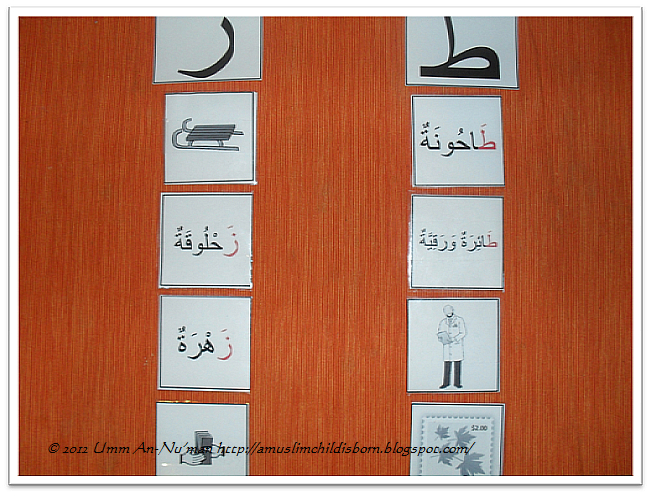
This game idea is helpful when studying the letters and the sounds they make. It is also helpful when children begin identifying the beginning sounds they hear in words. The game also helps build students' vocabulary. The teacher/teacher-parent can introduce new and more complex words to children as the children study the alphabet. The teacher/teacher-parent sits with the child and tells him/her what the object is on each card (if the child needs this support) and the child, listening for the beginning sound in the word, places the card under the letter that represents the beginning sound he/she hears. The child is listening for the beginning sound in each word but in the process he/she will also acquire new words and expand his/her vocabulary insha'Allaah. You may wish to start with 1 or 2 letters (with object/word cards for each letter) only when playing this game and as students gain skill and confidence you can use 3-4 letters (and object/word cards). If laminated, this game can be used in your classroom each year and will, insha'Allaah, withstand student handling. 
 
Children self-correct with ease in this game which makes it ideal for learning centres. To confirm if they have placed the cards in the correct row, children simply turn the cards over one at a time and check to make sure the first letter - highlighted in red - is the same letter on the letter card at the top of the mat. Children do not need to know how to read to play this game.


Control of Error

The next game helps children work on concept development. 

What Goes Together Game

Children are presented cards and must decide which cards go together. This association is based on how we use objects and/or how objects are complimentary. The teacher/teacher-parent prepares cards that show objects that he/she is confident his/her students are familiar with and know the usage of (i.e. the object).  

One way this game can be used is: the teacher presents the lesson and may begin with four cards (i.e. two pairs of objects). For example, the teacher may present a card with a toothbrush, a card with a pair of socks, a card with a tube of toothpaste and a card with a pair of shoes. The teacher, simply and briefly, discusses with the child which objects go together and matches the cards accordingly. The teachers takes a minute to discuss why these objects go together and then he/she using the same cards and a new set of cards as well, invites the child to do the activity independently. 

Before explaining to the child why two cards go together, you may wish to allow the child to draw on his/her prior knowledge and work from there. So before telling him which objects go together and why, ask him/her which cards he/she thinks go together. Allow the child to match the cards. If they are incorrect do not immediately correct the child. Invite him/her to explain their reasoning for placing the two cards together. If it is indeed an error, discuss with the child the reasons the two cards do not go together and then show and discuss which cards actually go together and why.

Making your own set allows you to expand the set as needed. For example, you may start with a set that has 10 cards (5 sets) and end up with a game that has 15-20 cards (or more!).


Insha'Allaah, you find these ideas helpful and beneficial for your class/child(ren). 


Enjoy insha'Allaah!

Tuesday, October 5, 2010

Different and Same Activity for the Letter Zay

السلام عليكم ورحمة الله وبركاته

This activity, "Different and Same", is one type of activity that is used in Montessori pre-school classrooms.


Just a close-up view

We used these cards to continue our work with the letter zay and to continue working on words that begin with that sound. In the pictures, all but one of the cards in the set are on the table but when presenting the activity, only the cards with letters were presented. The cards with pictures can be presented in a separate lesson insha'Allah.

To do this activity, present the cards, one at a time, to the child. Give them some type of marker chip to place over the letter or picture that is different from the rest. You can see an example of these cards on Montessori for Everyone.com. I made these for our specific study purposes and you may find that these can be made for many different themes (i.e. Hajj, Salat, Fall/Autumn, etc.) as they are easy to make and to assemble alhamdulillah.

During the activity, we briefly talked about why the letter that was different did not belong with the other letters on the card. For example, one of the letter cards has the letter seen three times and then one circle shows the letter zay. We talked about why zay was different from the letter seen: it's physical characteristics that are different (i.e. it's shape, it has a dot on top, etc.), the sounds it makes, etc. and then we moved on to the next card.

I would recommend that this type of activity not be used for children not yet in pre-school (or pre-school aged), however, you know your child best. If you feel that he/she is prepared for such an activity then this is a decision that rests in your hands and again, this is one of the many benefits of homeschooling: you can present to your child what you feel he/she is ready to encounter and be introduced to.

A side note: I didn't provide a link to download the file because...I can't seem to find it subhana'Allaah!....lol.

Enjoy insha'Allah!

**Oh! Did you enter the latest Smart Ark Giveaway yet? If not, click here to do so insha'Allah! **


Monday, March 29, 2010

Islamic Colouring Activity

Assalamu aliakum,

This is a fun colouring activity that also allows parents/teachers to quickly assess if a child:

1). Is able to follow simple directions.
2). Knows some of their colours.

This is a simple Islamic colouring activity that has four matching direction cards. Each card has a simple fact about each picture and a request to colour each picture a specific colour insha'Allah. The parent/teacher reads the card to the child and then invites him/her to colour the picture the colour indicated on the card.


Parents and teachers can use this to quickly assess if a student is able to accomplish the two tasks mentioned above. This also allows the parent/teacher to get a snapshot of some skills the child may need further work in or to confirm that the child has mastered certain learning outcomes insha'Allah.

For parents of younger toddlers, this can be used to teach some basic colours insha'Allah or....you can just allow your child to colour and have fun insha'Allah! You can download the file here insha'Allah.  

Enjoy insha'Allah!

Saturday, January 16, 2010

Silhouette Cards for Fruits and Vegetables from Canon.com

Assalamu alaikum,

I thought I'd share this exciting find with you all insha'Allah. It complements the latest Recommended Book: Up, Down and Around. These are Silhouette Fruit and Vegetable Cards that are a free download from Canon.com!


They even give you the template for the box to store them in! (That took me a while to put together...lol)

These cards (those were easy to put together alhamdulillah), are a fun extension to use with the book, Up, Down and Around, or any great picture book about fruits and/or vegetables insha'Allah. The back of the cards have silhouettes of a fruit or vegetable and the child is invited to guess which fruit or vegetable that silhouette belongs to. 

And....when you print out the directions to assemble the cards and box, an answer key/chart comes with it but don't throw it away! It's small but you can do so much with it even if your child doesn't need it. Here are just a few ideas that come to mind alhamdulillah:

- Make a lift-the-flap book for an infant. First they see the silhouette and then they lift the flap to reveal the fruit that the silhouette belongs to insha'Allah.

-  Make a mini/travel size memory game to take in the car to give the kids some fun on the way to your destination insha'Allah. The children can turn all of the cards over and try to find the fruit and its matching silhouette insha'Allah.

- If you use the game in your class, put the game in a centre and laminate the answer chart for students to use as a control (i.e. they check their answers with the chart) insha'Allah.

Lots more I'm sure insha'Allah but I won't keep you in suspense insha'Allah. Okay, maybe just a bit longer...hehe...but it's for a good reason. The Canon Creative Park site has sooo many neat free downloads in areas like science, vehicles, crafts, and more! And, the site is in French, Dutch and a few other languages subhana'Allah. Okay, I'm finished doing PR for Canon...hehe. You can download the game here insha'Allah.

Oh yes! If you can, print the box on cardstock insha'Allah. That way it's more durable insha'Allah.

Enjoy insha'Allah!

Saturday, December 19, 2009

Masaajid & Colour Domino Games

Assalamu alaikum,

This coming week we are going to play two games insha'Allah: Masaajid Dominoes and Colour Dominoes. I've had these games ready for a few days but I had to check to make sure it was permissible in Islam because I am aware that some games (such as those that use dice, exchanging money, betting, etc.) are not permissible. Alhamdulillah, the Sheikh said that these games were permissible and waallahu alim.

Both games are easy and fun so children four years old and up may enjoy them insha'Allah. The children simply match the masjid or colour to the piece that is on the table. For example, in the game below, the piece that began the game was a piece that had the same masjid on each side. The next piece that was placed on the table had to have at least one side that had the same masjid as the first piece. So the game extends out from there with the children matching the pieces based on the masaajid needed insha'Allah. The colour game is played in the same way, only matching colours instead of masaajid insha'Allah.

Here is the Masaajid Domino Game:


This is the Colour Domino Game:


The colour domino game can be used to help children learn colours and reinforce their existing knowledge of colours insha'Allah. I do not doubt that you all will also find other great ideas to use with these games insha'Allah and I invite you to share insha'Allah (smile). 

I printed both games on card stock but I also glued them to poster board just because I wanted extra thickness insha'Allah. I did not laminate the pieces of this game. I think the card stock on the poster board should be sufficient insha'Allah.

Here are the files insha'Allah:


Enjoy insha'Allah!

Tuesday, December 8, 2009

Rizq: Fruit Bingo

Assalamu alaikum,

Here is another game for the Riqz theme: Fruit Bingo. The objecive of the activity is to learn that rizq (provisions) come from Allah Alone and for children to become familiar with the spellings of common fruits insha'Allah. Accompanying the game is a sample lesson plan about teaching children that the rizq comes from Allah and after learning this concept insha'Allah, children can play this familiar game and work on identifying/naming fruits insha'Allah.


Control of Error is built into this activity in the following way insha'Allah: Each box has the name of a fruit and in the bottom corner of the box, there is a picture of that fruit to help the child if they cannot read the name quickly (or at all) this way they can still play the game insha'Allah.

To play, a parent/teacher says the name of a fruit. The child, who has circular fruit chips, looks for the correct fruit and places it in the box of the fruit that was just called out. There are more chips than boxes for a specific reason: each child will have the same card insha'Allah but the parent will give each child different chips - but making sure they have the chips they need to match all fruits insha'Allah. To win the game, the child has to get four in a row, across, down or diagonal.

Download Rizq: Fruit Bingo Game insha'Allah

Download Riqz min Allah Lesson Plan insha'Allah

Enjoy insha'Allah!

Saturday, June 20, 2009

Passage of Time Puzzles Re-Uploaded

Assalamu Alaikum, My dear sister Um Yusuf, My apologies, when I was editing my website recently I forgot to re-upload the puzzles and did not realize it. Jazakillahu khayr for bringing this to my attention. Please download them below insha'Allah and I have re-uploaded them on my site alhamduillah. 

 Passage of Time Puzzles/ Salat Time Puzzles

Friday, May 15, 2009

Passage of Time Puzzles

Assalamu alaikum,

This might be the last of puzzles for a while insha'Allah. I'm on to crafts! insha'Allah. I picked up a pretty nice craft book from the library and I'm going to try some things out insha'Allah. If I see anything that is suitable for infants/toddlers/twos, I'll be sure to share with you insha'Allah.

On to our last puzzle insha'Allah. This puzzle, with its accompanying activity worksheet, is designed to introduce toddlers & twos to the concept of the passage of time in a fun, non-intimidating manner insha'Allah. The directions accompany the puzzle and the worksheet is quite simple. As you talk about the types of things your family does around the time of day that each of the salawaat occurs, have the child draw a picture representing that activity insha'Allah. I've put one picture in each box as an example and your child(ren) can colour those pictures insha'Allah.

The puzzles themselves have the Control of Error that I really like to use. Control of Error is usually built into certain activities and it allows the child to self-correct without needing to depend upon an adult. This gives the child a sense of accomplishment and self-worth. It is meant to build a sense of "I did it myself alhamdulillah" and that's a good thing. Toddlers and twos are at a stage when they are discovering independence and they treasure the ability to do things on their own. Control of Error supports that need by setting the child up for success insha'Allah. They may not get it right the first time but no problem insha'Allah, over time they will notice the cues that are in the activity to help them and 'viola!' one day they get it insha'Allah. A side note: If you notice the child getting frustrated or they ask for help - help. If they don't try on their own but go immediately to asking for your help, gently encourage the child to try it first on their own and then stay nearby as an emotional anchor insha'Allah.

Now, finally, what is the control of error in these puzzles? The picture that shows what the sky looks like when each salat comes in is also on the word matching part of the puzzle. I hope that made sense insha'Allah. When you open the file, insha'Allah, you'll see what I mean.

I hope your child(ren) enjoy and benefit from the puzzles insha'Allah.

Related Posts Plugin for WordPress, Blogger...